Coronary Culprit Localizer
Combine EKG with regional wall motion abnormalities to estimate the most likely culprit vessel
EKG · Anterior and Lateral
Use the most specific pattern present.
LAD
ST elevation V1–V2
Septal involvement, favors LAD
LAD
ST elevation V3–V4
Anterior pattern, usually mid LAD territory
Lat
ST elevation I/aVL
Lateral injury, branch depends on precordial reciprocal pattern
D1
I/aVL + V2 elevation with III/aVF depression
South African flag pattern, strongly favors a diagonal branch, usually D1
OM
I/aVL elevation with V2 depression
Favors LCx obtuse marginal / lateral branch over diagonal
Lat
ST elevation V5–V6
Lateral LV, often LCx / OM or distal LAD
Prox
Anterior STE + aVL elevation + inferior reciprocal depression
Supports LAD occlusion proximal to a major diagonal branch
EKG · Inferior, Posterior and RV
RCA
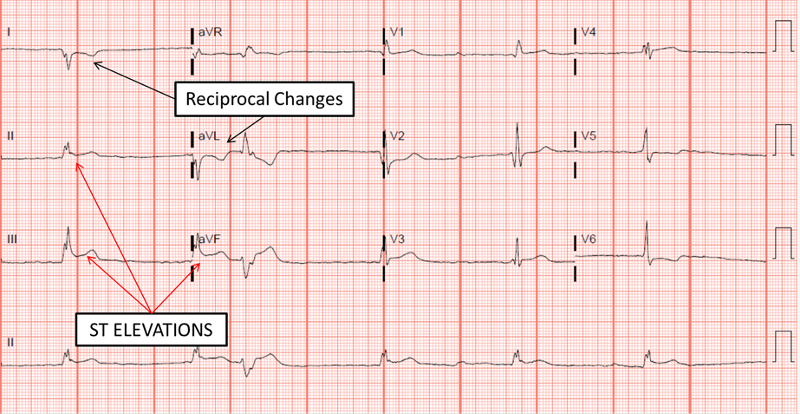
Inferior STE with III > II
Favors RCA over LCx
LCx
Inferior STE with II ≥ III
Favors LCx, especially with a leftward injury vector
RCA
ST depression aVL > I
Additional support for RCA in inferior STEMI
Post
ST depression V1–V3 or STE V7–V9
Posterior infarction, commonly distal LCx or RCA / PDA territory
RV
ST elevation V4R
Strongly supports proximal RCA with RV branch involvement
LAD
Anterior + inferior STE
Can reflect a distal wrap-around LAD when the anterior pattern is dominant
Echo · Regional Wall Motion
Segment-level abnormalities improve branch localization but coronary anatomy varies.
Basal anteroseptal / basal anterior
Supports proximal LAD
Mid anteroseptal / mid anterior
Supports LAD, usually proximal to mid vessel
Apical anterior / apex
Supports mid-distal LAD
Anterolateral wall
Diagonal or LCx / OM depending on accompanying segments and EKG
Inferolateral wall
LCx / OM common, RCA possible with right dominance
Inferior wall
RCA / PDA or dominant LCx
RV free wall
Supports proximal RCA
Global LV hypokinesis
Poor culprit localization. Consider left main / multivessel or nonischemic causes
Context
Left-dominant circulation known
Shifts inferior/posterior localization toward LCx
Wrap-around LAD known
Makes distal LAD more plausible with apical/inferior involvement
Diffuse ST depression + aVR elevation
High-risk global subendocardial ischemia pattern, not specific for left main
EKG Territory → Coronary Artery → Echo
Hover or tap an EKG territory to map the leads to the likely culprit artery and highlight the corresponding wall on PSAX and apical echo views.
V1–V2
Septal
LAD
Septal perforators
Echo correlation
Septal / anteroseptal LV. Evaluate A4C, A3C, PLAX and PSAX.
V3–V4
Anterior
LAD
Echo correlation
Anterior LV and apex. A2C is particularly useful.
I, aVL
High lateral
LCx / diagonal
Echo correlation
Anterolateral LV. Evaluate A4C, A3C and lateral PSAX segments.
V5–V6
Lateral
LCx / OM
sometimes diagonal
Echo correlation
Lateral and inferolateral LV. Evaluate A4C, A3C and PSAX.
II, III, aVF
Inferior
RCA > LCx
depends on dominance
Echo correlation
Inferior LV. Best seen in A2C and inferior PSAX segments.
V1–V3 ↓
or V7–V9 ↑
RCA / LCx
Echo correlation
Inferolateral / posterior LV. Evaluate A3C, PLAX and PSAX.
V1–V4R
RV infarct
Proximal RCA
Echo correlation
RV free-wall dysfunction. Use A4C and an RV-focused view.
Septal infarct pattern
V1–V2 abnormalities localize toward the septal / anteroseptal LV.
Typical culprit
LAD · septal perforators
Apical Wall Correlation
A4C
A2C
A3C
EKG leads
I
aVR
V1
V4
II
aVL
V2
V5
III
aVF
V3
V6
Echo views to interrogate
A4C
A2C
A3C
PLAX
PSAX
RV-focused
Echo:
interrogate the septal and anteroseptal myocardium in A4C, A3C, PLAX and PSAX.
Reciprocal patterns
Common Reciprocal EKG Changes
| STE Territory | Common Reciprocal ST Depression |
|---|---|
| Anterior | Inferior leads |
| Lateral | Inferior leads |
| Inferior | High lateral leads, especially I and aVL |
| Posterior | Anterior leads, appearing as ST depression V1–V3 |
References
1
Rao SV, O'Donoghue ML, Ruel M, et al.
2025 ACC/AHA/ACEP/NAEMSP/SCAI guideline for the management
of patients with acute coronary syndromes.
J Am Coll Cardiol. 2025.
doi:10.1016/j.jacc.2024.11.009.
View guideline
View guideline
Primary ACS Guideline
2
Byrne RA, Rossello X, Coughlan JJ, et al.
2023 ESC guidelines for the management of acute coronary syndromes.
Eur Heart J. 2023;44(38):3720-3826.
doi:10.1093/eurheartj/ehad191.
View guideline
View guideline
EKG Localization
3
Cerqueira MD, Weissman NJ, Dilsizian V, et al.
Standardized myocardial segmentation and nomenclature for
tomographic imaging of the heart.
Circulation. 2002;105(4):539-542.
doi:10.1161/hc0402.102975.
View publication
View publication
17-Segment Model
4
Lang RM, Badano LP, Mor-Avi V, et al.
Recommendations for cardiac chamber quantification by
echocardiography in adults.
J Am Soc Echocardiogr. 2015;28(1):1-39.e14.
doi:10.1016/j.echo.2014.10.003.
View ASE/EACVI recommendations
View ASE/EACVI recommendations
Echocardiography
5
Zhou P, Wu Y, Wang M, et al.
Identifying the culprit artery via 12-lead electrocardiogram
in inferior wall ST-segment elevation myocardial infarction:
a meta-analysis.
Ann Noninvasive Electrocardiol.
2023;28(1):e13016.
doi:10.1111/anec.13016.
View meta-analysis
View meta-analysis
RCA vs LCx
6
Durant E, Singh A.
Acute first diagonal artery occlusion:
a characteristic pattern of ST elevation in noncontiguous leads.
Am J Emerg Med. 2015;33(9):1326.e3-1326.e5.
doi:10.1016/j.ajem.2015.02.008.
View publication
View publication
D1 / South African Flag
7
Birnbaum Y, Drew BJ.
The electrocardiogram in ST elevation acute myocardial infarction:
correlation with coronary anatomy and prognosis.
Postgrad Med J. 2003;79(935):490-504.
doi:10.1136/pmj.79.935.490.
View review
View review
Coronary Anatomy
8
Bozbeyoğlu E, Yıldırımtürk Ö, Aslanger E, et al.
Is the inferior ST-segment elevation in anterior myocardial
infarction reliable in prediction of wrap-around left anterior
descending artery occlusion?
Anatol J Cardiol. 2019;21(5):253-258.
doi:10.14744/AnatolJCardiol.2019.09465.
View publication
View publication
Distal / Wrap-Around LAD