
| INPUTS | Invasive Hemodynamics | OUTPUT | Units | Normal Values |
|---|---|---|---|---|
|
MAP
|
Cardiac Output (CO) | -- | L/min | 4-6 L/min |
|
SpO2
|
Cardiac Index (CI) | -- | L/min/m^2 | 2-4 L/min/m^2 |
|
ScvO2
|
SvO2 (%) | -- | % | 65-75% |
|
Hgb
|
SaO2 (%) | -- | % | 94-100% |
|
BSA
|
SVR | -- | (dynes*sec/cm^5) | 900-1400 dynes*sec/cm^5 |
|
ABPs
|
PVR | -- | Woods Units | <2.8 Woods Units |
|
ABPd
|
RA (Mean) | -- | mmHg | 1-6 mmHg |
|
ABPm
|
PA (S/D/Mean) | -- | mmHg | 25/10/15 mmHg |
|
PAPs
|
PCWP (Mean) | -- | mmHg | 6-11 mmHg |
|
PAPd
|
AO (S/D/Mean) | -- | mmHg | mean >60 mmHg |
|
PAPm
|
CPO | -- | W | If <0.6, LV failure |
|
PAWP
|
PAPI | -- | If <0.9, RV failure | |
|
CVP
|
Swan Interpretation
| Pattern | CVP | PCWP | CI | SVR | PVR | PAPI | CPO |
|---|---|---|---|---|---|---|---|
| Right HF | ↑ | Normal or ↑ | ↓ | ↑ | ↑ | <0.9 | Normal or ↓ |
| Left HF | Normal or ↑ | ↑ | ↓ | ↑ | Normal or ↑ | Normal or ↓ | <0.6 |
| Tamponade | ↑ | ↑ | ↓ | ↑ | Normal or ↑ | ↓ | ↓ |
| Hypovolemia | ↓ | ↓ | ↓ | ↑ | Normal or ↓ | Normal or ↑ | ↓ |
| Cardiogenic shock | ↑ | ↑ | ↓ | ↑ | ↑ | ↓ | ↓ |
| Sepsis / distributive | ↓ | ↓ | ↑ | ↓ | ↓ or Normal | Normal or ↑ | Normal or ↑ |
Swan Basics
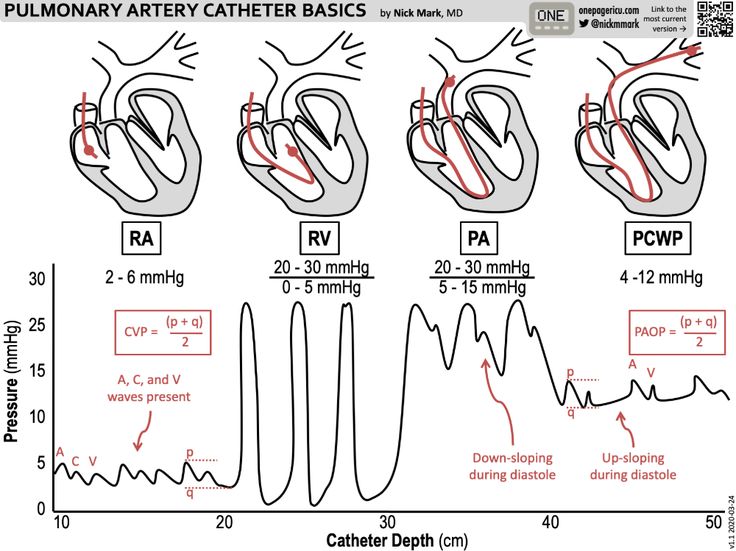
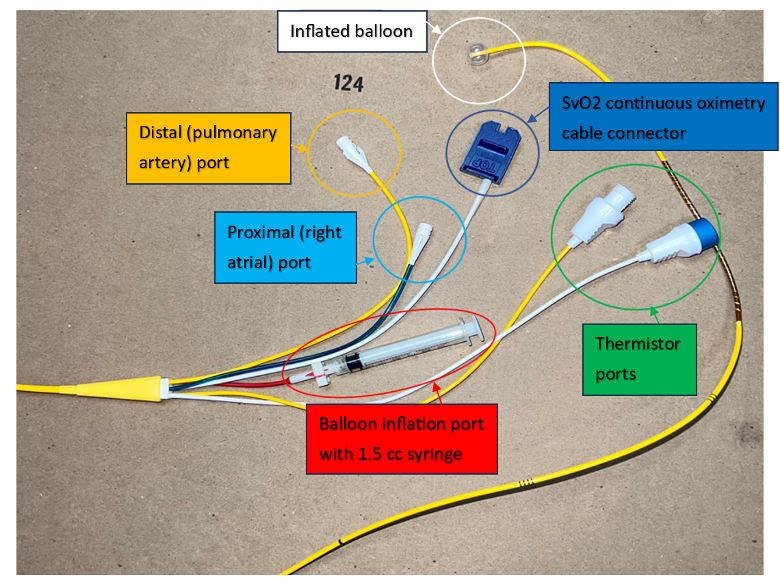
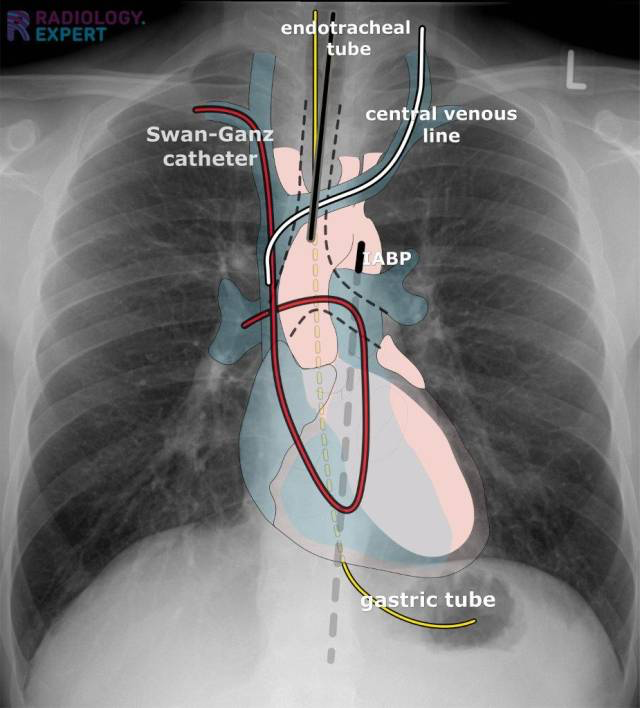
CXR Placement
- Path: SVC → RA → RV → PA → branch
- Ideal tip: Proximal R/L pulmonary artery, ~3–5 cm beyond carina, near hilum
- Too proximal: In RV → arrhythmia risk
- Too distal: In segmental PA → rupture risk
Equations
Cardiac output (CO)
- CO (L/min) = (125 × BSA) / [(SaO2 − ScvO2) × 1.36 × 10 × Hgb]
Cardiac index (CI)
- CI (L/min/m²) = CO / BSA
Systemic vascular resistance (SVR)
- SVR (dynes·sec/cm^5) = 80 × (MAP − CVP) / CO
Pulmonary vascular resistance (PVR)
- PVR (Wood units) = (PAmean − PCWP) / CO
Cardiac power output (CPO)
- CPO = (MAP × CO) / 451
Pulmonary artery pulsatility index (PAPI)
- PAPI = (PAPs − PAPd) / CVP
References
- Swan, H. J. C., Ganz, W., Forrester, J., Marcus, H., Diamond, G., & Chonette, D. (1970). Catheterization of the heart in man with use of a flow-directed balloon-tipped catheter. New England Journal of Medicine, 283(9), 447–451. https://doi.org/10.1056/NEJM197008272830902
- Forrester, J. S., Diamond, G., Chatterjee, K., & Swan, H. J. C. (1976). Medical therapy of acute myocardial infarction by application of hemodynamic subsets. New England Journal of Medicine, 295(24), 1356–1362. https://doi.org/10.1056/NEJM197612092952406
- Stevenson, L. W., & Perloff, J. K. (1989). The limited reliability of physical signs for estimating hemodynamics in chronic heart failure. JAMA, 261(6), 884–888. https://doi.org/10.1001/jama.1989.03420060100040
- Nohria, A., Tsang, S. W., Fang, J. C., Lewis, E. F., Jarcho, J. A., Mudge, G. H., & Stevenson, L. W. (2003). Clinical assessment identifies hemodynamic profiles that predict outcomes in patients admitted with heart failure. Journal of the American College of Cardiology, 41(10), 1797–1804. https://doi.org/10.1016/S0735-1097(03)00309-7
- Mendoza, D. D., Cooper, H. A., & Panza, J. A. (2007). Cardiac power output predicts mortality across a broad spectrum of patients with acute cardiac disease. American Heart Journal, 153(3), 366–370. https://doi.org/10.1016/j.ahj.2006.11.014
- Kang, G., Ha, R., Banerjee, D., & Pulmonary Artery Pulsatility Index Investigators. (2016). Pulmonary artery pulsatility index predicts right ventricular failure after left ventricular assist device implantation. Journal of Heart and Lung Transplantation, 35(1), 67–73. https://doi.org/10.1016/j.healun.2015.06.007
- Bertaina, M., Galluzzo, A., Rossello, X., Omedè, P., Montefusco, A., Totaro, S., Bocchino, P. P., Frigo, A. C., Iannaccone, M., De Ferrari, G. M., & D’Ascenzo, F. (2022). Pulmonary artery catheter monitoring in patients with cardiogenic shock: Time for a reappraisal? Cardiac Failure Review, 8, e15. https://doi.org/10.15420/cfr.2021.18